Five ways to use a voice profile
Short answer: ask ChatGPT whether a draft sounds like you and it will say yes. voice-profile-mcp gives a different kind of answer. It counts ten surface features of your writing (sentence length and rhythm, short and long sentence shares, contractions, pronouns, questions, paragraph shape) in code, not with a model. The same text gets the same numbers every time. It never writes anything; your own AI client does the rewriting, guided by the numbers. Here are the five uses we think are worth your time.
1. Keep your voice when AI drafts for you
For founders and executives who have ChatGPT or Claude draft posts and emails under their name.
Build a profile once from 8 to 12 pieces you wrote yourself, before AI. Save it; the server keeps no copy. Then run every AI draft through check_draft. It returns pass or fail per feature and the direction to move, for example: long sentences 31%, your range 8 to 18%, shorten. Paste the failures back into the chat as edit instructions and check again. You stop when it passes, not when the model says it is done.
2. One writer, several channels
A LinkedIn post, a board memo and a newsletter should not read the same. Label your samples by channel and build one profile with a range for each. Then check each draft against its own channel, never the others.
Two findings usually follow. Some features stay the same across every channel: those are your voice. Others move with the format, and now you know by how much. And sometimes the profile shows two channels overlap completely, which means you do not actually write them differently. If you are not sure you have distinct modes at all, give it 8 or more unlabeled pieces first and see whether it finds two.
3. Diagnose your style against 40 writers
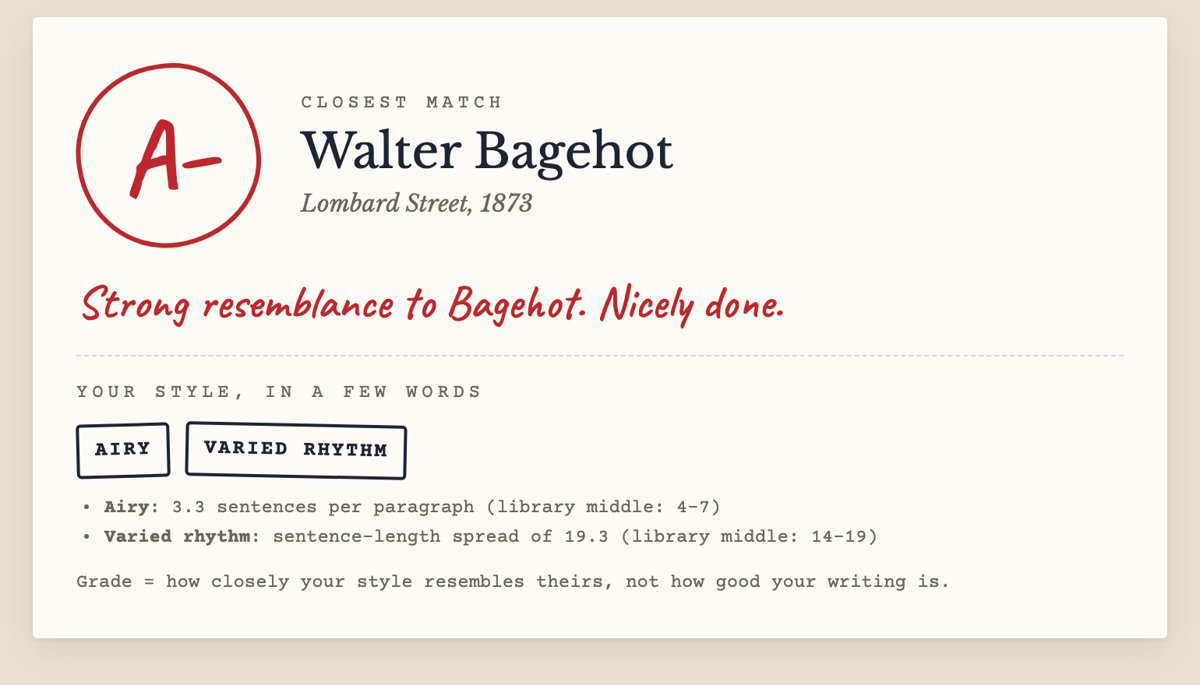
The server compares your writing with 41 public-domain books by 40 writers, from Jane Austen and Mark Twain to Frederick Winslow Taylor and Emily Post. Do not stop at the overall match. Read the closest writer for each feature: that tells you which habit to change.
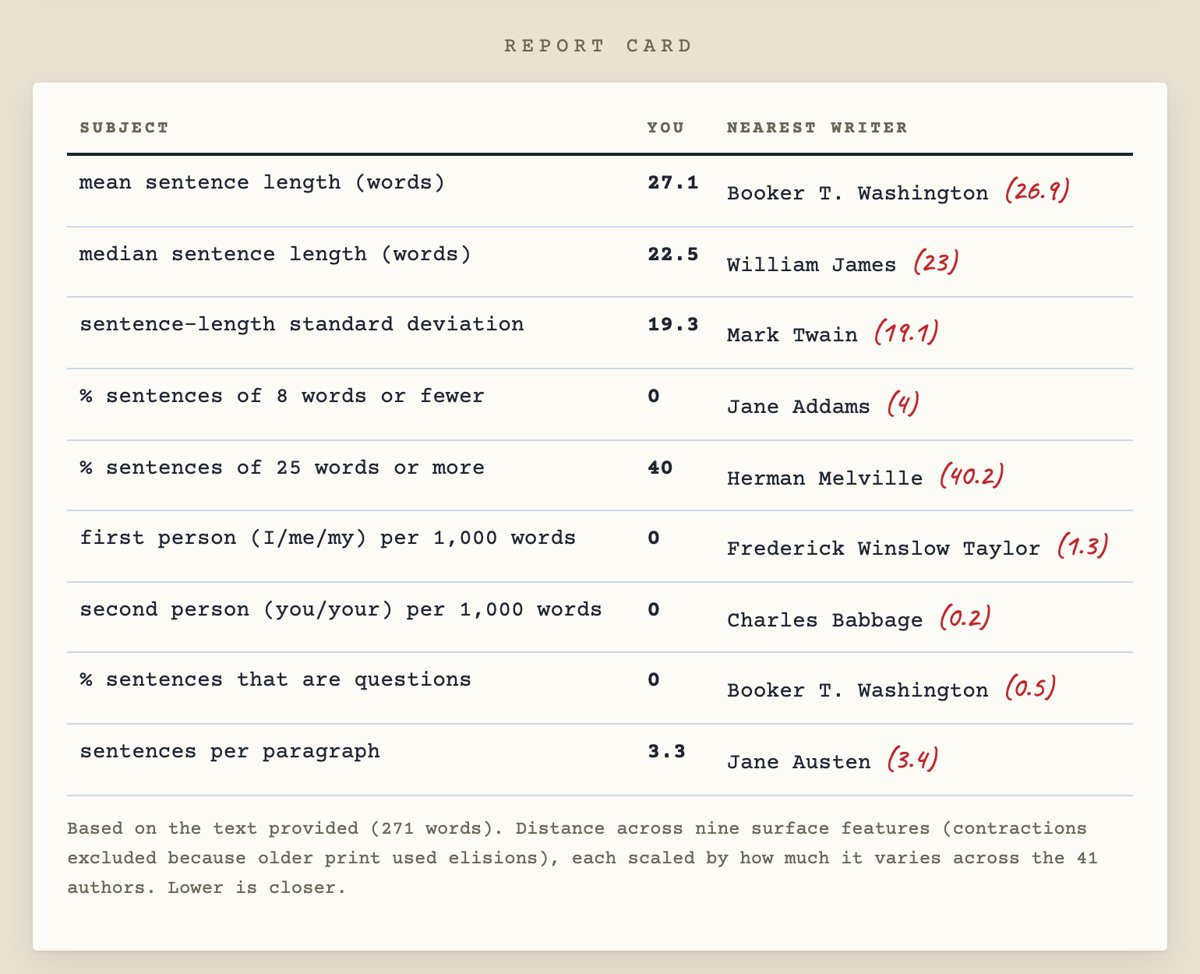
Two checks that the measuring works. The Gettysburg Address lands closest to Walter Bagehot (0.65), and second closest to a biography of Lincoln. Hemingway's two novels in the library pick each other (0.39) without being told they share an author. Lower is closer.
If readers call your writing dense, the report card shows which lever is doing it. Lincoln's share of 25+ word sentences matches Melville almost exactly; his sentence-length spread matches Twain.
4. One spec per client, for ghostwriters and agencies
"Make it sound more like Dana" is not a brief. Build one profile per client from their own writing, keep it with their banned-word list, and run check_draft before every delivery. Both sides see the same numbers. Because the server stores nothing, client samples are not retained anywhere.
The profile describes how the client writes, not how they wish they wrote. If they want to sound different, change the profile on purpose.
5. House style as an automatic check
For content leads with several writers, or teams producing AI copy at volume. Build one house profile from approved pieces plus a banned-word list. A script calls check_draft on every piece before it reaches a reviewer, with no AI model in the loop. A reviewer's taste varies by the day. This does not.
What it will not do
It measures the surface of the writing. A draft can pass every feature and still argue something you would never say. It is not an AI detector and cannot prove who wrote a text. The "How it reads" panel in the demo describes the writing, never the writer.
The tool does not create a unique style either. Being far from 40 dead authors is not originality. What it does is help you find the style you already have, then hold it.
Try it
- In a browser: voice.citrusworks.io. No sign-up; nothing is stored.
- In ChatGPT or Claude: add
https://voice.citrusworks.io/mcpas a custom connector. Setup steps. - The code is open source on GitHub.